When you have felt trapped for long enough, destruction can look like freedom.
You imagine handing in your notice, ending the relationship, selling the house, moving abroad or starting a completely different business. The appeal is not always the new life itself. Sometimes it is simply the thought of no longer having to live this one.
I understand that urge. I have left careers, built two seven-figure businesses and seen both end, one by the 2008 crash and one by Brexit, moved countries, returned to work I thought I had left behind, and rebuilt after anxiety and depression reduced my world to almost nothing. I am changing direction again now because a damaged knee and medical advice make physical construction a bad long-term future.
I am not writing from the other side of a perfect transformation. I am still working out how to replace the income that construction provides. That unfinished position is precisely why I do not recommend dramatic leaps dressed up as courage.
Escape and rebuilding are different decisions
Escape asks, "How quickly can I stop feeling this?" Rebuilding asks, "What life am I trying to create, and what must remain stable while I test it?"
The first question is understandable, especially when you are exhausted. It is also vulnerable to poor decisions. A review of research on stress and decision making found that stress can change how people evaluate risk and reward. The effect is not identical for everybody, but it is a good reason to avoid treating your most overwhelmed moment as your clearest one.
Before you decide that everything must change, understand why a life that looks good can still feel empty. The missing part may be smaller and more specific than the urge to escape suggests.
Keep what is sound
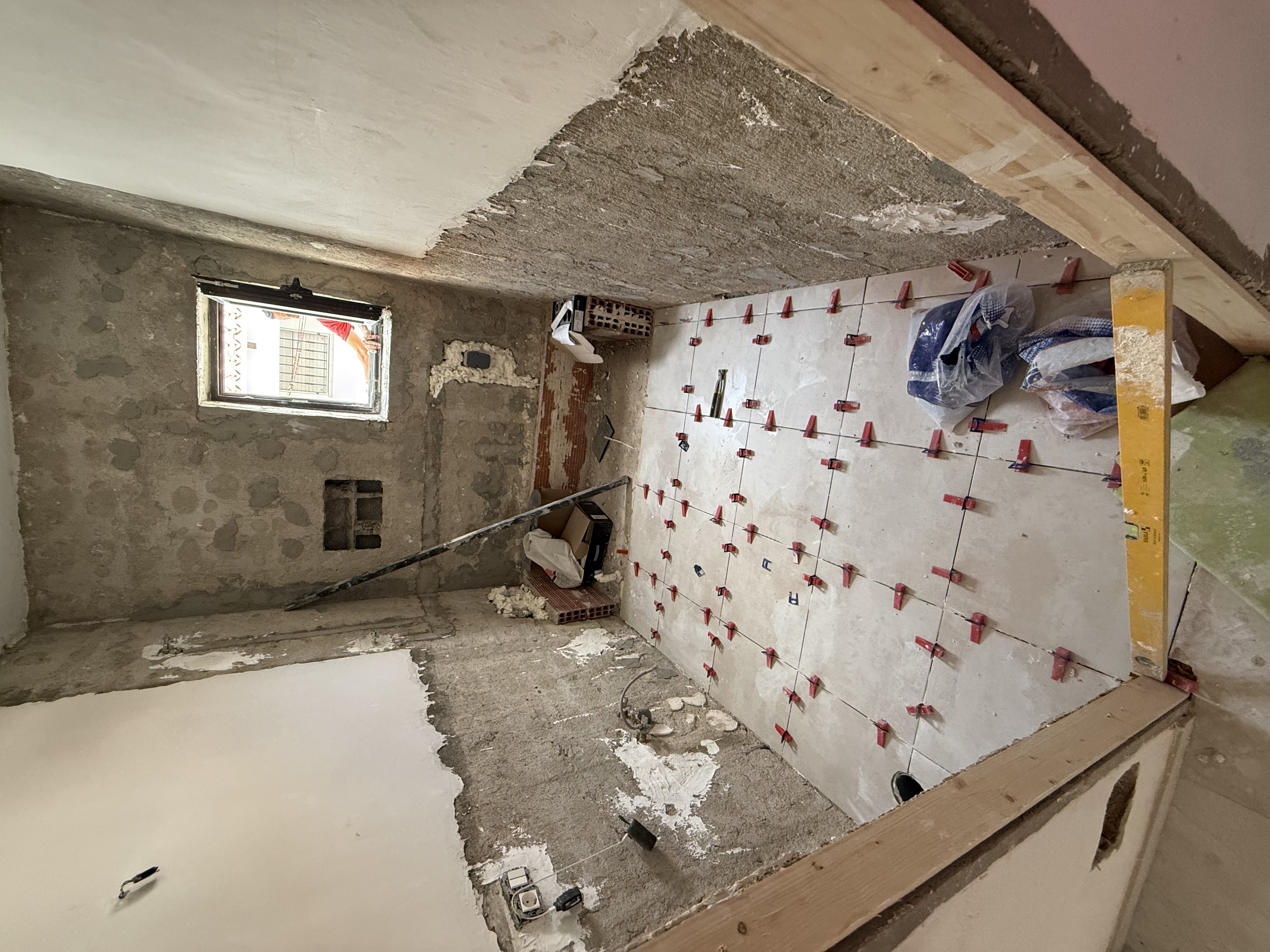
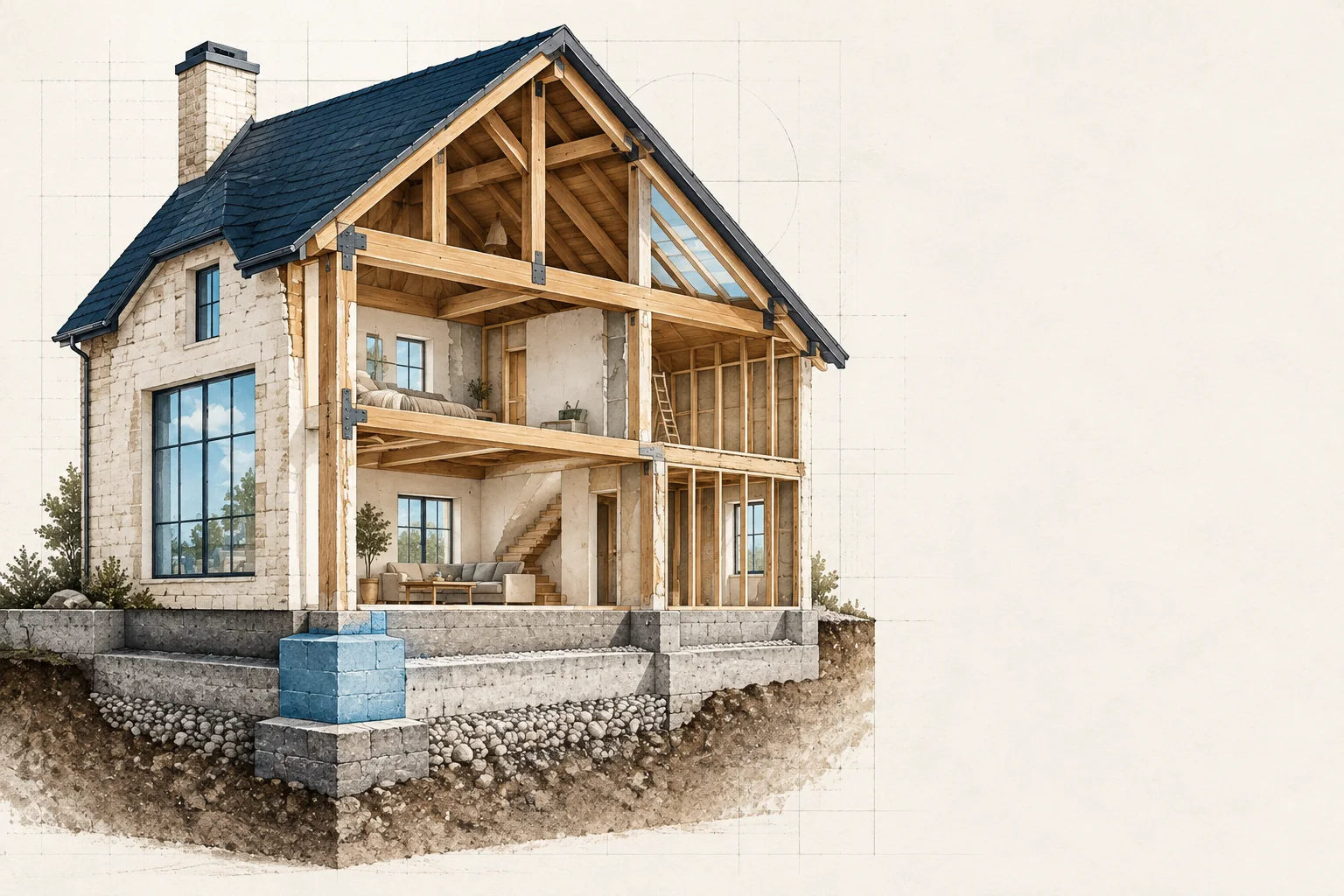
When a builder renovates a house, the first job is not to knock everything down. You inspect the structure. You keep what is sound. You support what is carrying weight. You remove what is damaged or no longer fits. Then you build from what remains. I wrote about that method in Renovation, Not Demolition.
A life works the same way. Your past still contains skills, relationships, reputation, lessons, routines, savings, responsibilities and evidence about what suits you. Even painful chapters contain usable material.
When the 2008 crash forced me to wind down my construction company, I lost the business but not the ability to sell, lead, solve problems or build something from nothing. When Brexit took every contract the transport company had, overnight, I still carried the experience of creating a complex operation. Today, construction may be ending as a career, but the builder’s way of seeing problems has become the language of Human Renovation.
Build a bridge before you leap
A bridge is any step that lets you test the new direction while the old structure still carries some weight. It could be reducing hours before resigning, taking one client before opening a business, spending a month in a place before moving there, attending counselling before ending a relationship, or trying a hobby before deciding you need a new identity.
The bridge is not cowardice. It is evidence.
Research on goal adjustment supports the value of releasing goals that have become unattainable and re-engaging elsewhere. The important word is re-engaging. Walking away creates a gap. A tested next direction gives your effort somewhere useful to go.

Protect the foundations that still work
The urge for change can make stability feel like the enemy. It is not. Stability gives you time to make a better decision.
Before a major move, identify what the decision could damage:
- Income needed for housing, food, debt and dependants
- Physical or mental health support
- Relationships that are safe and worth preserving
- Professional reputation, qualifications and useful contacts
- Routines that keep you functioning when motivation drops
Protecting a foundation does not mean staying forever. It means refusing to create avoidable emergencies while trying to solve a different problem.
A practical 7 day 30 day and 90 day approach
The first seven days. Delay irreversible action unless your safety is at risk. Write down what you want to leave, what you want to move towards, and what you cannot afford to damage. Speak to one person who will challenge your thinking rather than simply encourage the escape.
The first thirty days. Test the smallest real version of the change. Do the work, have the conversation, attend the session, spend time in the environment or serve the first customer. Research is useful, but contact with reality is better.
The first ninety days. Look at the evidence. Did the new direction hold your attention after the novelty faded? Can it fit your health and relationships? If it must provide income, has anybody paid for it? What runway would you need before reducing the old source of stability?
If you still do not know what you are building towards, start with how to find purpose again. A bridge needs a destination, even if that destination becomes clearer as you move.
Small change is not the same as playing small
People often assume that a serious problem requires a dramatic solution. Sometimes it does. An unsafe relationship, a serious health risk or an unethical workplace may demand decisive action. In many other cases, the life is not entirely wrong. One part has been neglected for so long that it colours everything else.
A new hobby can restore interest. Better boundaries can return time. A different role can use the same skills without the same pressure. One honest conversation can change a relationship that has been running on assumptions. A side project can prove whether a new career is real or simply attractive from a distance.
Small changes are powerful because they provide feedback without demanding that you gamble your entire life on a theory.
When the change involves work
Do not confuse hating the current conditions with loving the proposed alternative. Test the actual work, not the image of it. Talk to people doing it. Calculate the minimum monthly income your household requires. Build skills and proof before announcing a date that your finances cannot support.
I have made this mistake myself. I entered transport because I saw an opportunity, not because I wanted the life of a transport operator. The company succeeded commercially for a time, but it depended too heavily on me and created a life I felt trapped inside. A viable opportunity and a viable life are different tests.
When the change involves a relationship
Do not stay in danger, coercion or abuse in the name of moving slowly. Get appropriate support and protect your safety. Where the relationship is safe but disconnected, try to separate the relationship itself from the pressure surrounding it. Exhaustion, work, loneliness, grief and loss of identity can all be experienced as "I need to leave." A counsellor can help you examine that without deciding the answer for you.
When the change involves your identity
Losing a title, business, income level or physical ability can feel like losing yourself. That is one reason people cling to chapters that have ended. List what the old identity proved about you. Perhaps you can lead, endure, learn, sell, create, care, organise or begin again. Those qualities can move into the next chapter even when the old role cannot.
The next brick
You do not need the confidence to complete the whole rebuild. You need enough evidence for the next responsible step.
For me, that means continuing to meet today’s responsibilities while building work that my knee can sustain and that gives me more freedom and contribution. It is slower than the fantasy of walking away tomorrow. It is also far more likely to leave the important parts of my life standing.
The fuller philosophy and practical exercises sit inside my book, The Rebuild. The principle is simple. Keep what works. Support what matters. Change one selected area. Then lay the next brick.
Get The Weekly Reset to choose one small focus for the week: free, five quick questions, nothing to buy.
Questions people often ask
Is it ever right to make a drastic life change? Yes. Safety, serious health risks and circumstances that cannot be repaired may require decisive action. The point is to make the action deliberate and supported, not to assume drama is proof of courage.
How much money should I save before quitting? There is no universal number. Calculate essential monthly costs, realistic transition time and what happens if the new plan earns less than expected. A financial adviser can help where the decision is substantial.
What if my family does not support the change? Listen for the concern beneath the resistance. They may fear financial or emotional instability rather than oppose your growth. A smaller test can give everybody better evidence.
How do I know whether I am escaping? If your plan is detailed about what you are leaving but vague about what you are building, escape is probably doing more of the thinking. Slow down and test the destination.
Sources and further reading
The research below supports the principles in the article. Associations are described as associations, not proof that one factor caused another.
- Starcke and Brand review stress and decision making - Stress can alter decision processes involving risk and reward.
- Wrosch and colleagues on goal disengagement and re-engagement - Adaptive self-regulation includes releasing unattainable goals and investing in new ones.
- Designing Your Life by Bill Burnett and Dave Evans - A popular practical approach that uses small prototypes to test possible futures.