Halfway through a bathroom refit, the room looks like a disaster. The suite is gone. The tiles are off, and the walls behind them are bare plaster and old adhesive in ugly brown ridges. There is a hole where the soil pipe leaves the building, dust on everything, and the family are brushing their teeth over the kitchen sink. Walk in knowing nothing and you would assume something had gone badly wrong.
I refit kitchens and bathrooms for a living, here in southern Spain. That stage is not a disaster. It is supposed to look like this. It is what the middle of a job looks like. Nobody photographs this bit for the brochure, but every finished bathroom you have ever admired went through it.
Most of the language around starting your life again gets that room wrong.
The survey comes first
Before a single tile comes off, you survey. You check where the water has been going, because water always goes somewhere. You check for damp. You put a level on the floor and find out whether it is solid or whether it moves underfoot. You work out which pipes are worth keeping and which need replacing. You find out what is behind the walls before you commit to what goes in front of them.
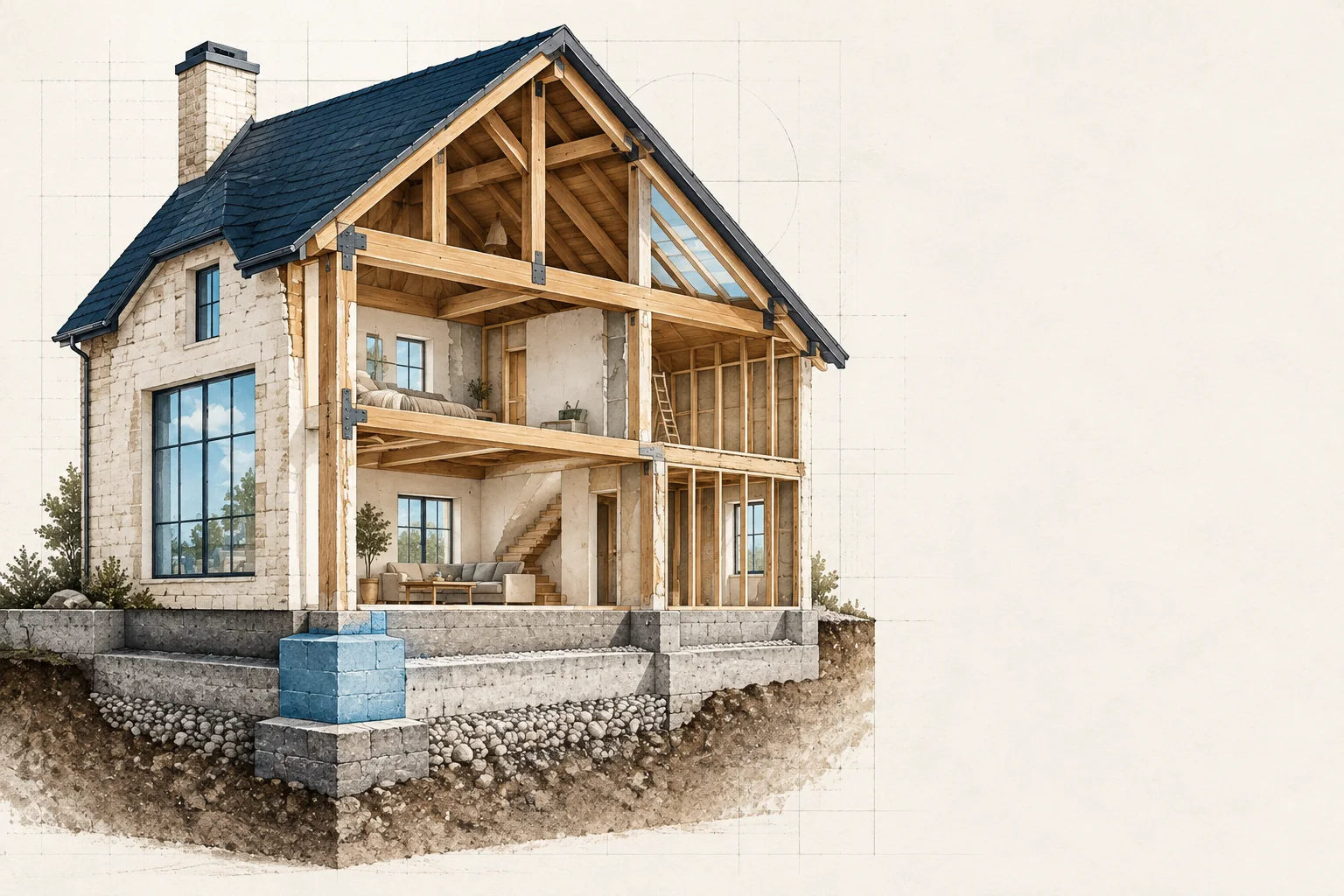
The survey has a double job: find out what has failed, and find out what is still sound. The second half is the one people forget. Even in a properly failed bathroom, one with rot in the floor and a leak that has been running for years, most of the building is fine. The walls hold. The roof holds. The structure that took the real time and the real money to put up is still standing and still doing its job. The failure is real, but it is local.
Nobody demolishes a house because the bathroom has failed. And yet listen to how people talk when their life stops working somewhere past forty. Burn it all down. Clean slate. Move to another country, become someone else, start from scratch. I have lived in seven countries, so I am in no position to sneer at the ferry-timetable fantasy. But that is demolition talk, and demolition talk does two damaging things.
First, it is dishonest about what you are actually carrying. Second, it makes starting again so expensive and so frightening that plenty of people never start at all. If the only option on the table is to flatten everything and rebuild from a bare plot, you put it off. Who has the money, the years or the nerve for that? So the failed bathroom stays failed, and you keep brushing your teeth in the kitchen, so to speak, for another decade.
What survives when a business ends
I have had two businesses end.
The first was a construction company I built in the UK to seven figures, subcontracting to large main contractors. After the 2008 crash, three things happened at once. The main contractors moved payment terms to 95 days from the end of the month. The banks withdrew overdrafts and stopped lending. The builders merchants withdrew credit and went cash on delivery. I would have had to carry around £20,000 a week in wages and materials for about four months, with no credit anywhere. So I finished the contract I was on, could not afford to take the next one, and wound the company down solvent, with money in the bank. The crash ended it. I chose how it ended.
The second was a haulage company I ran from 2014 to 2018. Brexit took every contract it had overnight. It went bankrupt and took about £250,000 with it.
Two very different endings. In neither case did I start again from zero.
The companies ended. The ability to price a job, run a contract and get up and work on the days when working was the last thing I felt like doing stayed with me. So did thirty years of knowing how buildings go together. What those endings taught me was expensive, and it was mine to keep.
That is the structure. Skills, judgement, relationships, scars with information in them, and the plain evidence that you have come through everything so far. When a marriage ends or a career ends or your body changes the plan, the loss is real. But the loss is the bathroom. It is rarely the house. A hard chapter leaves rubble, and it also leaves materials.
But the loss is the bathroom. It is rarely the house.
Renovation is not the soft option
"Renovate rather than demolish" can sound like a way of dodging the hard part. It isn't. Anyone who has done a strip-out knows it is the most brutal phase of the job. Things come out. Things you paid good money for, things that used to work, things you have simply got used to stepping around. The strip-out is where you commit, because once the old suite is in the skip there is no pretending the room was fine as it was.
Starting your life again has the same phase, and it is just as unglamorous. Habits come out. Sometimes a role you have played for twenty years comes out. A business you built gets carried down the stairs in pieces. Renovation does not spare you any of that. What it spares you is the lie that everything must go, and the paralysis that lie produces.
It also gives you an order of works. Nobody strips a room without knowing what is going back in, and nobody fits the new taps before the pipework is done. Survey, strip out, first fix, and only then the finish. A life rebuilt in that order feels completely different from a life attacked at random. You know why today looks like a mess. You know what stage you are at. The dust is evidence the job has started, and nothing more.
That matters most in the middle, at the stripped-out stage. If you are there now, recently divorced, recently redundant, recently carrying a loss you did not choose, your life may look like that bathroom with the suite gone and the walls scarred. Every instinct says disaster. A tradesman would look at exactly the same room and say: stage two. It is supposed to look like this. What matters is whether you have surveyed, whether you know what is sound, and whether you know what goes in next.
Keep looking as the job moves
A survey is not a one-off. On any refit you keep checking as the work goes on: what is done, what has turned up behind the tiles, what goes in next. Jobs drift when people stop looking.
A life under renovation needs the same habit. A short, honest look once a week does more than a grand plan once a year.

Your survey this week
Take one sheet of paper and write three short lists. What has genuinely failed. What is still sound. The one thing that goes in next. Keep it to one page, and be as honest about the sound parts as the failed ones.
Then do the one thing before the week is out. You have more standing structure than you think. Survey it, strip out what has genuinely failed, and build on the rest.
Get The Weekly Reset to make that look a weekly habit: free, five quick questions, nothing to buy.